

Across the United States, Continuums of Care (CoCs) serve as the backbone of regional homelessness response systems. They coordinate public funding, align service providers, manage data systems, and lead strategic planning efforts designed to reduce homelessness and improve housing stability.
Yet many CoCs operate within a narrow funding structure that relies heavily on federal and local government resources. While public funding remains essential, the absence of diversified private funding can limit flexibility, slow innovation, and constrain the ability of communities to respond to emerging challenges.
Private philanthropy has the potential to strengthen homelessness response systems, but traditional nonprofit fundraising models often do not translate easily to system-level organizations.
The Structural Funding Challenge Facing CoCs
Continuums of Care operate in a complex environment where responsibility for system performance often exceeds available flexible funding.
Federal funding streams administered through the U.S. Department of Housing and Urban Development support critical programs, including permanent supportive housing, rapid rehousing, and coordinated entry systems. However, these funds are typically restricted and designed to support direct services.
At the same time, CoCs are expected to:
- Coordinate multi-agency systems
- Facilitate cross-sector collaboration
- Manage data and performance measurement
- Support prevention and system innovation
- Align public policy and community planning
These functions represent system infrastructure, yet they are rarely funded at the level necessary to support sustained innovation and long-term strategic planning.
The result is a structural funding gap.
Without diversified funding sources, many CoCs struggle to invest in the coordination, strategy, and problem-solving capacity that ultimately improves system outcomes. Traditional nonprofit fundraising often focuses on individual service delivery. Donors are accustomed to supporting tangible outcomes such as meals served, beds provided, or individuals housed.
Continuums of Care operate differently. Their impact lies in building systems that allow communities to respond effectively to homelessness. This work includes:
- Coordinating housing resources across providers
- Operating coordinated entry systems
- Aligning government and nonprofit partners
- Integrating healthcare, housing, and workforce strategies
- Identifying system gaps and developing solutions
In effect, CoCs function as civic infrastructure organizations.
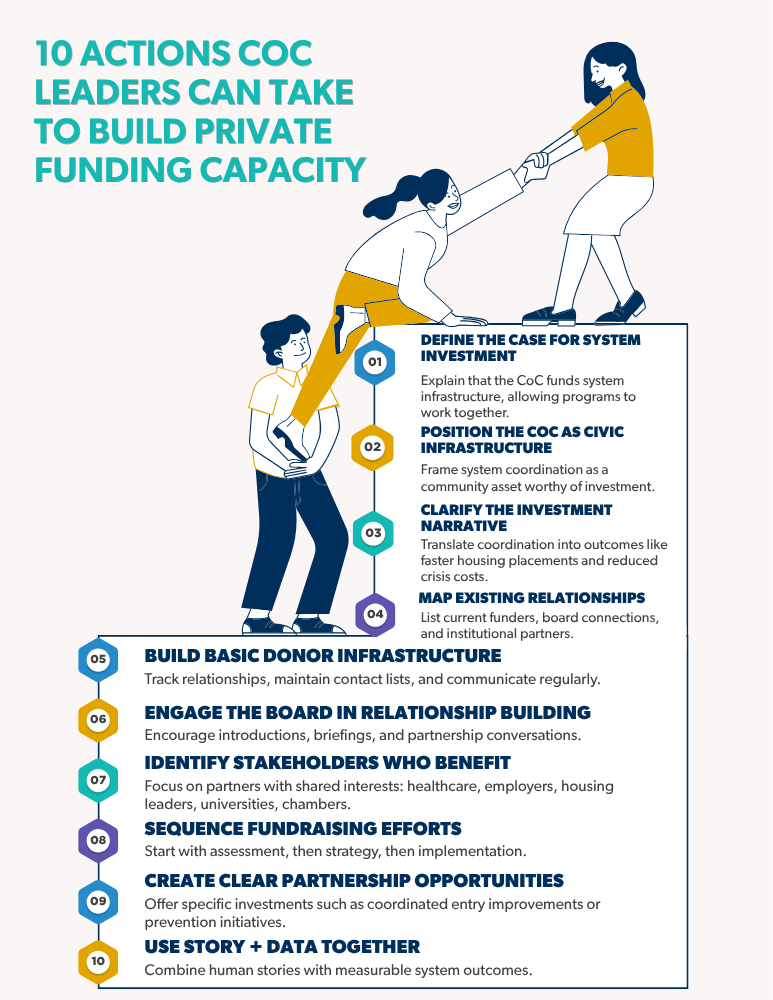
Their success strengthens the performance of the entire regional homelessness response system. Recognizing and communicating this role is essential to building sustainable private funding support.
System Infrastructure Funding Model
Under this funding model, private philanthropy supports the backbone functions that enable effective system performance. These investments typically support areas that are difficult to fund through traditional grants, including:
- Cross-sector coordination
- Data and performance improvement
- Prevention and diversion strategies
- System innovation and rapid response
- Community engagement and partnership development
Rather than funding individual services, donors support the capacity that makes those services more effective. When framed correctly, this model allows private investors to understand that their contributions improve the performance of the entire system rather than a single program.
Storytelling for System-Level Impact
Effective fundraising requires communications strategies that combine human impact with measurable system outcomes. For CoCs, storytelling must operate at two levels.
First, human stories grounded in lived experience provide emotional resonance and help donors understand the real consequences of housing instability.
Second, these stories must connect to broader system outcomes such as:
- Housing placement rates
- Reductions in crisis system costs
- Improved coordination across service providers
- Measurable improvements in housing stability
When narrative and data are integrated, donors gain confidence that their investment contributes to meaningful system improvements.
Strategic Sequencing for Fundraising Growth
Successful fundraising expansion typically follows a staged approach.
The first stage focuses on assessment and data organization, allowing organizations to understand their existing donor relationships and engagement opportunities.
The second stage involves strategy development and early engagement, translating system-level work into clear investment opportunities.
The final stage focuses on implementation and institutionalization, ensuring that fundraising efforts become integrated into organizational culture and governance structures.
This sequencing helps organizations build momentum while avoiding operational overload.
How Tier One Solutions Can Help
Melissa Kozakiewicz & Tier One Solutions work with nonprofit organizations, public agencies, and civic coalitions to design sustainable funding strategies, strengthen cross-sector partnerships, and translate complex social challenges into clear, investable solutions.
We bring experience in:
- public-private funding strategies
- homelessness prevention systems
- governance and board engagement
- strategic communications and narrative development